Why water matters
Minerals in water help extract flavour. Magnesium and calcium bind to flavour compounds, while bicarbonate (alkalinity) buffers acidity. Too few minerals (distilled or reverse-osmosis water) give flat, sour, hollow coffee. Too many, especially high alkalinity, give chalky, dull coffee and scale up machines. Chlorine and chloramine from municipal treatment add off-flavours.
What good brewing water looks like
The Specialty Coffee Association publishes a water quality standard for brewing. In plain terms: clean and odourless, no chlorine, a modest total mineral content (roughly 75–250 mg/L total dissolved solids, with about 150 mg/L as a target), moderate calcium hardness, modest alkalinity (around 40 mg/L) and a near-neutral pH. You don't need lab tests, but if your kettle scales quickly, your water is hard.
Simple fixes
- Use a carbon filter pitcher to remove chlorine and odours; some also reduce hardness.
- Avoid distilled water on its own; it makes flat coffee.
- Try a low-mineral bottled spring water if your tap is very hard.
- Brewing water mineral packets let enthusiasts build water from distilled.
- Descale machines regularly if you have hard water.
Water temperature
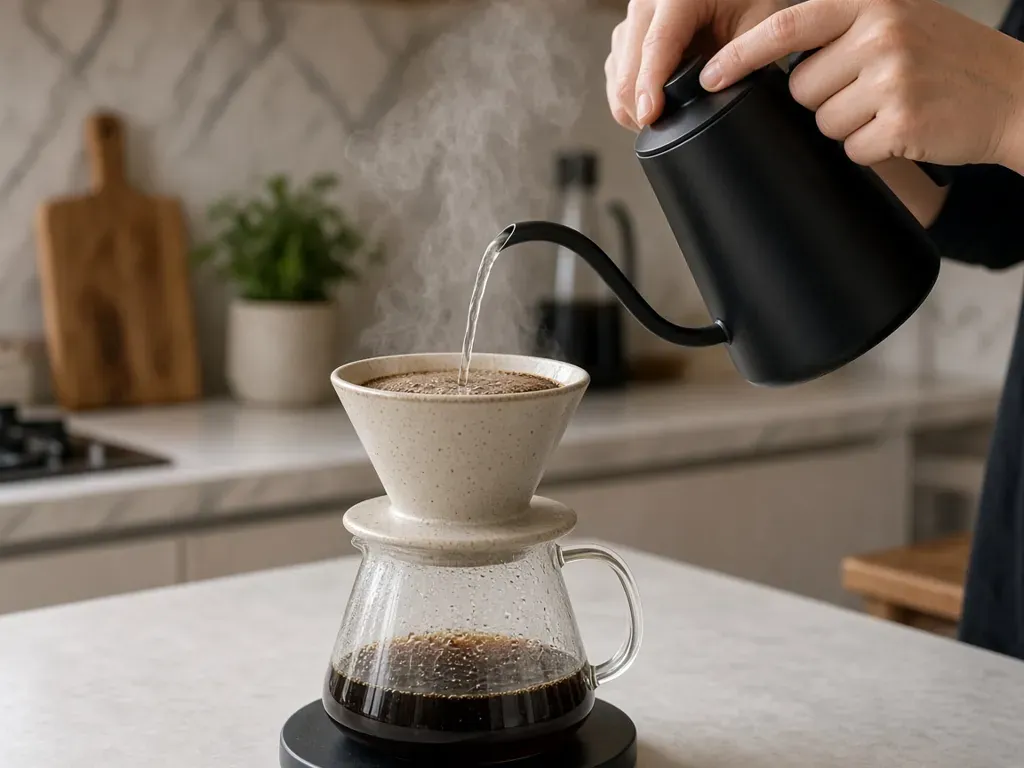
For hot brewing, aim for about 90–96 °C (195–205 °F). Use the hotter end for light roasts and the cooler end for dark roasts. Water straight off a rolling boil and rested 20–30 seconds is close enough for most methods.
Frequently asked questions
Is tap water OK for coffee?
Often yes, especially filtered. If it tastes of chlorine or scales your kettle quickly, filter it or use low-mineral spring water.
Why is distilled water bad for coffee?
Without minerals, extraction is poor and coffee tastes flat.